

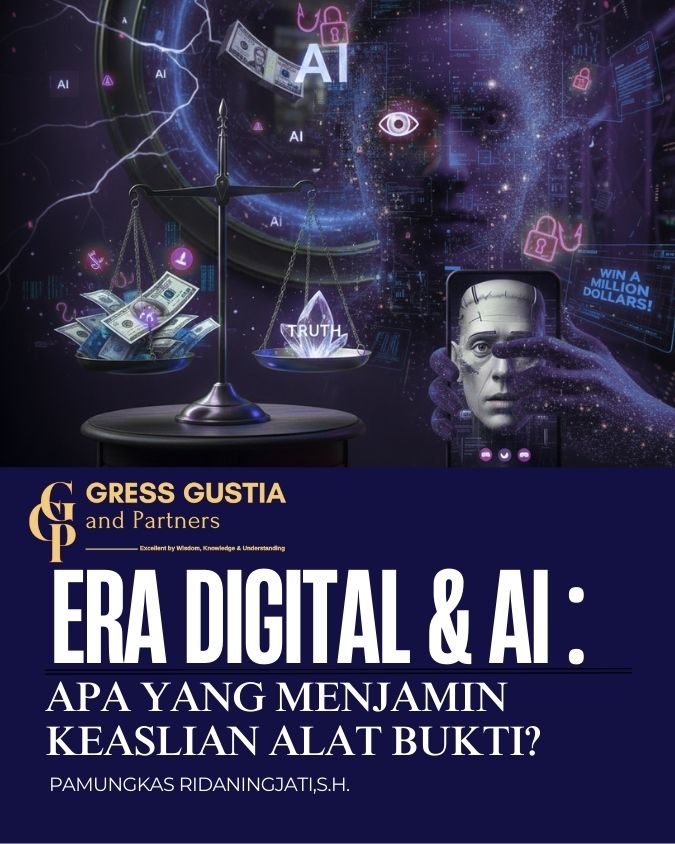
The phenomenon of fraud conducted through
phone calls and even video calls using the faces and voices of well-known
individuals has become increasingly widespread. These schemes utilize
artificial intelligence (AI) to convince victims into engaging in business
transactions, online loans, or even disclosing personal data. This condition
demonstrates that technology is capable of generating falsified evidence that
appears genuine and convincing, even when such events never actually occurred.
Since the enactment of Law of the Republic
of Indonesia Number 11 of 2008 on Electronic Information and Transactions
and its amendments (the ITE Law), Article 5 paragraph (2) essentially
provides that electronic evidence is legally admissible in court proceedings.
This means that screenshots, video recordings, digitally signed documents, and
other electronic documents have the status of evidence as long as they meet the
criteria of integrity and authenticity. Integrity refers to the
completeness of the electronic document as a whole, while authenticity means
that the document can be accounted for in explaining the facts or circumstances
(vide Article 5 of the ITE Law).
The potential issue arises from the inherent
nature of electronic documents, which can be manipulated through advanced
artificial intelligence. Even the metadata of electronic messages can be
altered through AI. As electronic documents can be modified, the authenticity
of the data can become obscured, thereby raising doubts about the reliability
of the electronic evidence.
In civil procedural law, the primary purpose
of proof is to ascertain formal truth, considering that the submitted
evidence forms the basis for the court’s judgment. Electronic evidence is
deemed admissible only if the information contained therein is accessible,
displayable, its integrity is assured, and it is accountable. However,
electronic evidence is vulnerable to manipulation, fabrication, or alteration
that may affect its authenticity and the truth of the information it contains.
Therefore, in determining the integrity and authenticity of electronic
evidence, verification is required to ensure that the document has not been
altered and originates from a legitimate source. To ensure this, specialized
expertise such as digital forensic experts is needed to examine system
logs, metadata traces, or conduct hash verification to confirm the
validity of electronic evidence and ensure that no manipulation or tampering
has occurred.
Nevertheless, forensic examination alone,
when analyzed, is insufficient to assess whether electronic evidence contains
potential manipulation. This is because digital forensic analysis is typically
conducted ex post, that is, after suspicion of manipulation arises.
Meanwhile, in practice, the types of electronic evidence continue to evolve and
grow increasingly complex. Thus, preventive measures (ex ante mechanisms)
are required through the application of the principle of prudence,
consistent with Article 3 of the ITE Law.
One form of preventive implementation is the
development of the Electronic Certification Provider System (PSrE) as
regulated in Article 16 of the ITE Law in conjunction with Government
Regulation No. 71 of 2019 on the Implementation of Electronic Systems and
Transactions, and the Regulation of the Minister of Communication and
Informatics No. 11 of 2022 on Governance of Electronic Certification Providers.
An Electronic Certification Provider (PSrE) is a legal entity serving as
a trusted third party responsible for issuing and auditing electronic certificates.
A PSrE may consist of domestic or foreign institutions registered and domiciled
in Indonesia, and must be verified by the Government of Indonesia.
Fundamentally, a PSrE is not a form of
evidence; rather, it is a verification mechanism ensuring that electronic
evidence is accountable and holds legal force. Any electronic document
accompanied by a PSrE certificate indicates that the user’s identity has been
verified, all changes to the document can be detected, and the time of such
changes is automatically recorded (timestamped). In essence, this
mechanism ensures that the document meets the criteria of integrity and
authenticity (vide Article 5 of the ITE Law), as such qualities are guaranteed
through a system monitored and officially verified by the government.
With the existence of PSrE certification,
judges and litigating parties have a clearer basis for assessing the
authenticity and integrity of electronic documents without immediately
resorting to complex technical examinations. PSrE acts as a preventive measure
to ensure that documents are not easily manipulated or forged, thereby
preserving confidence that the submitted documents are truly intact and
originate from legitimate parties.
Thus, one of the guarantees of the
authenticity of electronic evidence is the use of electronically certified
documents issued by PSrE. Meanwhile, other digital documents may be
verified through digital forensic experts. In this digital and AI-driven
era, it is no longer sufficient for evidence to merely appear genuine or
convincing; instead, verification of the authenticity of electronic or digital
documents is essential.
Therefore, if GGPeople intends to submit
electronic documents, they must first validate their authenticity to ensure
that each submitted document is secure and protected from rejection as court
evidence.